

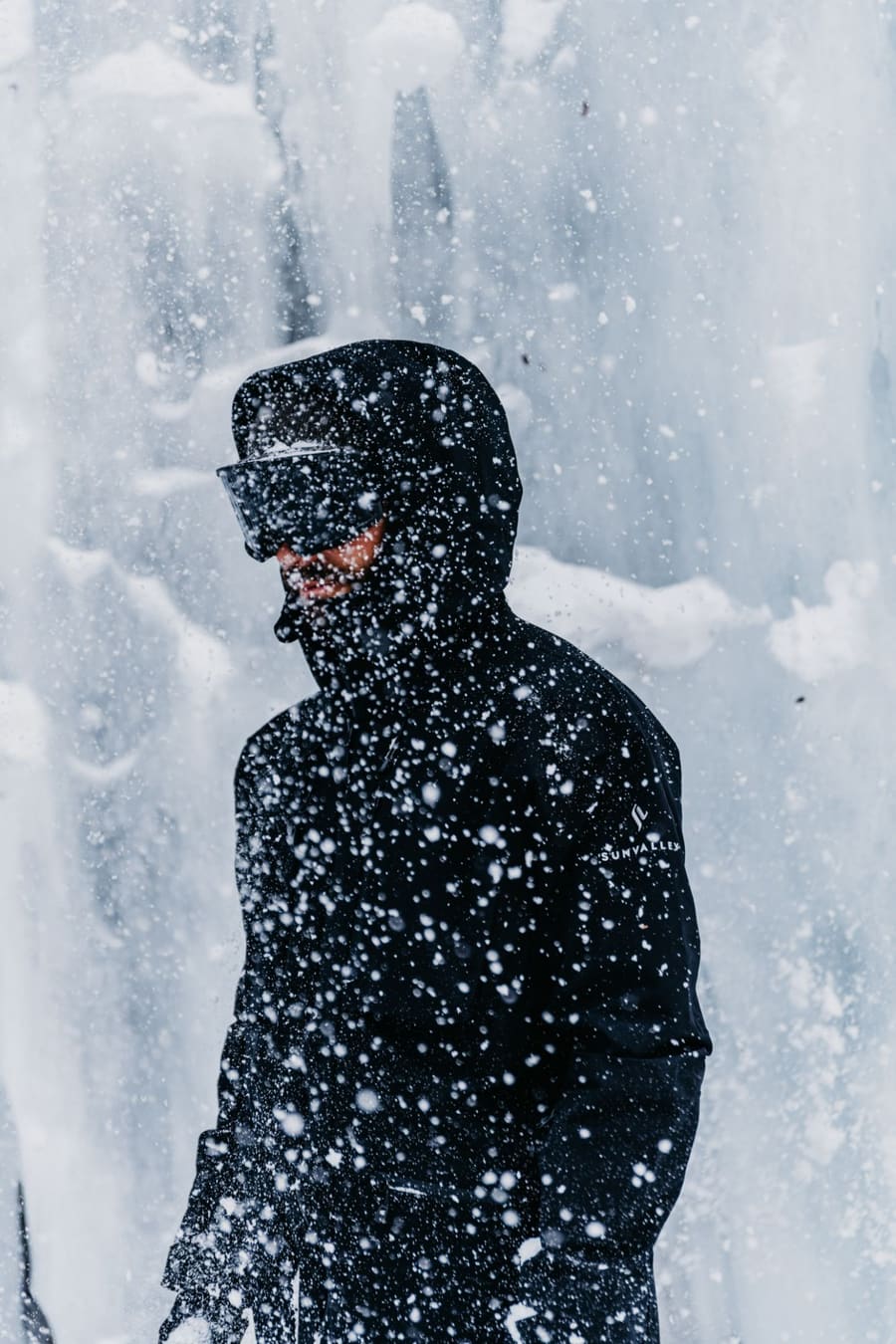
Understand what you wear
Waterproofing in Schmerber, breathability in grams, 2-way or 4-way stretch, taped seams: our product pages talk about all of this. Here's what these words mean, and what we choose for our clothing.
Technical design
Waterproofing is measured in the lab with a hydrostatic pressure test and expressed in Schmerber: the height, in millimeters, of a column of water placed on the fabric before the water passes through it within one hour. The higher the number, the more waterproof the fabric.
During sport, clothing is subjected to pressure (friction, backpack, falls). A fabric rated 8,000 mm is considered enough to stay dry in moderate rain. Our clothing offers 10,000 mm to 20,000 mm.
Breathability is a garment's ability to remove the moisture produced by the body. It is probably the most important factor in a technical fabric: sweat gets out, you stay dry, and therefore warm.
The most common measurement expresses the grams of water vapor that one square meter of fabric lets through in 24 hours. Below 5,000 g, the fabric breathes little; from 10,000 g, it performs well; 20,000 g is very high breathability. Our clothing ranges from 10,000 g to 20,000 g.
A stretch fabric brings real comfort outdoors. All our jackets also have a stretch lining, for a consistent construction.
2-Way Stretch: a weave that gives mechanical stretch across the width.
4-Way Stretch: elastane in the weave, for maximum stretch across both width and length.
Hybrid Stretch: 4-Way panels on a 2-Way base, stretch where it counts.
Seams are sealed with adhesive tape or membranes that stop water from getting through the stitch holes, without losing breathability.
Main seams taped: seams sealed in strategic areas (hood and shoulders on jackets, seat and knees on pants).
All seams taped: every seam is sealed, for complete waterproofing.
Features and technologies
Warmth comes mainly from the mid layer worn under the jacket. S-warm is our standard for these insulating layers: an excellent balance of thermal insulation and breathability, soft, easy care, quick drying, and recycled.
TechWool combines bamboo viscose, merino wool and elastane: the comfort and thermal properties of wool, good sweat wicking, and no odor thanks to the natural fibers.
A membrane laminated to the inside of the fabric blocks water and lets sweat through. Microporous membranes, the most common type, have holes too small for a drop of water but large enough for vapor.
The Dermizax membrane from Japanese manufacturer Toray is not microporous: its flexible structure breathes by capillary action, all the more as the body warms up, and keeps all of the fabric's stretch. A benchmark in the mountains.
Between the outer fabric and the lining, a layer of lofty insulation traps air, a highly effective natural insulator. Primaloft synthetic insulation is the benchmark: it retains body heat, stays insulating even when wet and breathes very well. We use no animal down.
A wet fabric makes you cold, even if the membrane blocks water, and its tightened fibers wick sweat less effectively. The water-repellent treatment makes water bead up and run off the surface of the fabric.
This treatment wears off with washing. Ours keep at least 80% of their performance after 5 washes, then can be reactivated with a suitable product. The Teflon EcoElite we use is free of fluorinated agents, made from bio-based materials, and keeps its performance after more than 30 washes.
Concepts and innovations
Three layers, each with its own job. The base layer, next to the skin, wicks away moisture: synthetic or merino wool, close-fitting. The mid layer keeps you warm by trapping air, thicker or thinner depending on the weather. The outer layer, a membrane jacket and pants, protects you from rain, snow and wind, with ventilation zips to regulate your temperature.
A shell jacket, breathable and protective, with Primaloft insulation targeted where your body needs it: chest, shoulders, upper back. Two layers in one, the protection of an outer jacket and the warmth of a mid layer.




Warmth exactly where you need it
A shell jacket with targeted Primaloft insulation: warm on the way down, no overheating on the way up.